
Chipmunks vs. squirrels

The Setting
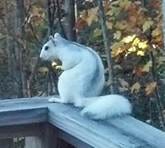
I sometimes have to explain that, though our address is Pisgah Forest, we do not live in Pisgah National Forest. Ours is just an unincorporated zip code near the national forest on the edge of Brevard, NC. Our neighborhood does, however, have a lot of trees. (Don’t ask our neighbors about Hurricane Helene.) It also has a lot of animals, including bears, deer, foxes, raccoons, possums (or opossums, if you prefer the Irish name), coyotes (reported), a bobcat, groundhogs, snakes, all sorts of birds, and, of course, chipmunks and squirrels. We even have white squirrels that are not albino, but a white variant of the eastern gray squirrel. They are nice to look at, but they are still squirrels. Here’s a picture of one on our deck several years ago.
Before I go any further, let me be clear that I understand all these critters have a place in the ecosystem. (Do mosquitos, though? Maybe food for bats?) I’m sure they contribute more than protein for owls and other predators, so please don’t take offense at anything that may seem at first insensitive or even malicious. We enjoy watching deer through our kitchen window as they forage in a wooded lot, even though they eat our flowers at night. I like to watch nearly all animals, even squirrels, from a distance, but I don’t find squirrels to be as much fun as chipmunks (or otters),
The case for chipmunks
I am a fan of chipmunks. It has nothing to do with Alvin, Simon, and Theodore, though I am old enough to remember fondly when they started. Nor is it related to the preference for chipmunks by Martin Marten, the eponymous nonhuman, nonspeaking character in Brian Doyle’s novel. [See note below.] Aside from their being cute little animals, when chipmunks cross the road, they tend to go in a straight line, moving their tiny legs very fast. No hesitation. No indecision.
This is a chipmunk crossing a road.

Squirrels on the other hand
I have never been a fan of squirrels. Aside from my frustration at failing to prevent them from keeping birds away and eating all the birdseed, even the hot pepper infused seed—they just wipe their mouths with their bushy tails and go back to it—they are a nuisance crossing the road. They can never make up their tiny minds which way they want to go. When you stop for them, they often freeze. If you try to straddle them, they restart the frantic scramble like a quarterback trying to escape being sacked by a herd of gigantic linemen. (What is the collective term for football linemen?) You would think an animal that was so adept at defeating every so-called squirrel-proof bird feeder could master the task of crossing the road. A few years ago I saw a sandwich board sign on the sidewalk outside a local wine bar that said (paraphrasing): “Make up your mind. The roads are littered with the flattened bodies of squirrels who could not make a decision.”
This is a squirrel crossing a road.

(I acknowledge there may be some who would see the previous diagram as illustrating the flow of my thought and writing.)
A surprising exception
A few days ago, as Jane and I were driving down the narrow road in our neighborhood, I saw a chipmunk beginning to cross the road. I slowed for it to do its usual fast beeline to the other side, but it stopped and began the back and forth I expect from a squirrel. My first thought was that there had been “a great disturbance in the Force.” (Thank you, Obi-Wan.) Eventually, it made it to the other side. Life returned to normal.
Later it occurred to me that the road crossing behaviors of chipmunks and squirrels is how people sometimes function, whether in making decisions or accomplishing tasks or writing a Substack or even setting government policy. I don’t need to spell it out.
A more flexible approach
There is one caution. All due respect to chipmunks, sometimes we need to be open to other directions when something important draws us away from the previous target. Being focused on a goal is often laudable. (As I learned when my late farmer cousin let me drive the tractor to plow a row when I was a kid. It was not a chipmunk row.) Being indecisive can be as paralyzing as, well, being frozen in place. However, having a vision so narrow that we can never be diverted from it may also be costly. Refusing to admit you need to go in another direction can result in missed opportunities, wasted time, anguish, defeat.
I have just begun reading a marvelous new novel for young readers by Philip Stead. While sailing or paddling in a boat on the River of Uncertainty, 12-year-old Bernadette realized that the river kept changing course. The author explains:
Bernadette took a deep breath to calm her mind. Then she lifted her extra-large cauldron spoon from the water and came to a conclusion that many clever people fail to reach in a lifetime of trouble and strife. She concluded: There is no use paddling in a river that cannot decide which way it is going. [This conclusion is one of the morals of the story that Bernadette, being a goatherd, sets off with small goat silhouettes, which I can’t reproduce here.]
How do you know when you need to change direction, or just stop paddling? Perhaps you could think back to times you have changed direction successfully. What influenced you? One critical component of changing directions successfully, I believe, is to admit that the previous direction was not the best one, or at least that the previous direction is no longer viable, fruitful, or fulfilling even if it was at some point, and that the new direction appears to be promising. This appears to be a lesson a great many of the current political caste could benefit from practicing. More than that must be a topic for another time.
Notes:
Brian Doyle, Martin Marten, Picador, 2016. Note: This Martin is not to be confused with Martin Martens, a Belgian botanist of the 19th century. This Martin, who is a marten, liked chipmunks, not so much for their taste, but because they were easy to take apart. (My apologies to fellow chipmunk lovers who are saddened by this image.)
Philip Stead, A Potion, a Powder, a Little Bit of Magic Or, Like Lightning in an Umbrella Storm, Neal Porter Books, 2026, p. 30.